Good fit
Batches using an approved ROPP cap, liner and bottle-neck finish where operator loading can support the required output.
Semi-automatic ROPP capper
An operator-fed roll-on pilfer-proof capping route that forms aluminium closures onto a compatible bottle neck using a dedicated roller head.
Direct model answer
The LU-XG60C-class machine is a semi-automatic ROPP capper for batches where an operator loads the bottle and closure and the machine forms the aluminium shell around the bottle-neck finish. ROPP performance depends on the cap shell, liner, pilfer band, bottle neck and roller setup as one approved pack system.
The values below are current Lancing reference data for initial project screening. They do not prove that every bottle and closure inside a dimensional range will run, or that the published rate will be sustained on a different line. Lancing confirms the final configuration, tooling, utilities, output and acceptance method against representative production samples and the complete application brief.
Published reference envelope
Use these values to decide whether the platform merits a sample review. Unknown or project-specific items remain part of the quotation and trial process.
| Published item | Reference value |
|---|---|
| Model reference | LU-XG60C class |
| Machine route | Semi-automatic roll-on pilfer-proof capper |
| Published cap range | 20–50 mm |
| Published bottle height | 60–350 mm |
| Published working speed | 25–30 bottles/min |
| Electrical supply | 110/220 V, 50–60 Hz |
| Power | 250 W |
| Approximate machine size | 420 × 600 × 1400 mm |
| Approximate net weight | 80 kg |
Machine route
The image supports identification of the machine route. It does not establish suitability for a different bottle, cap, speed or line arrangement.
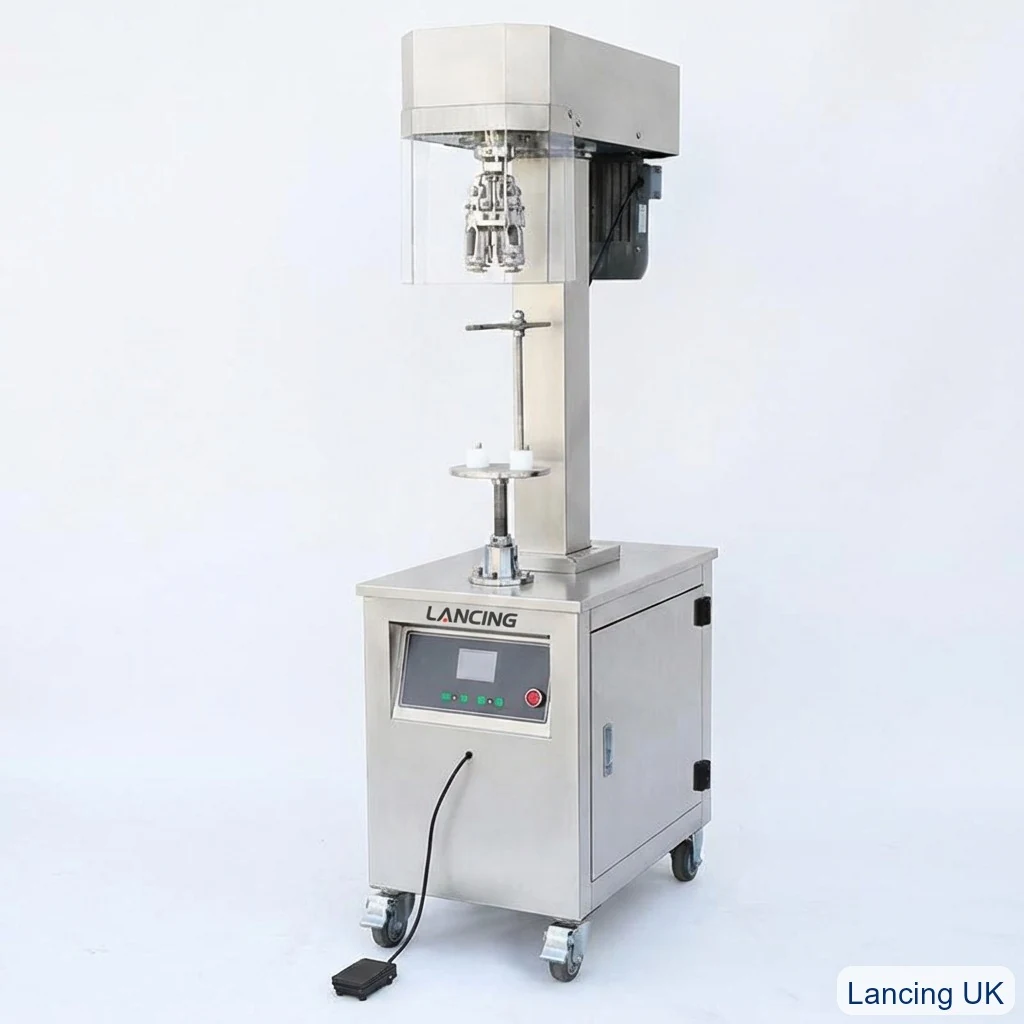
LU-XG60C class
Published first-party model image used as a visual reference. Final guarding, tooling and line arrangement are confirmed for the quoted machine.
Selection boundary
This route suits controlled batch production of compatible aluminium closures where an operator can place each cap and bottle. It is fundamentally different from tightening a pre-threaded plastic screw cap because the rollers form the thread and tamper feature during the cycle.
Batches using an approved ROPP cap, liner and bottle-neck finish where operator loading can support the required output.
Lightweight or unusual bottles, decorative aluminium shells, multiple neck standards and packs where sealing or opening performance has tight acceptance criteria.
Use an automatic multi-head ROPP line when sustained output, cap feeding and automatic bottle transfer exceed the practical operator-assisted cycle.
Production evidence
A dimensional cap range cannot prove compatibility. The trial should confirm cap placement, top-load support, thread formation, pilfer-band roll, liner contact, finished appearance, opening behaviour and repeatability across normal component lots. Record the approved head and roller setup for each format.
Use the intended bottle-neck drawing, cap-shell specification and liner or sealing element.
Confirm the container is located and supported without damage while the head applies the required forming load.
Inspect the formed thread, skirt and tamper feature rather than relying on cap height alone.
Use the site-approved opening, leak or closure-integrity method appropriate to the product and pack.
Quotation and trial brief
A useful quotation should describe the operating duty and acceptance evidence, not only the nominal bottle and cap diameter.
Provide filled production bottles, every closure variant, component drawings where available, product condition and the least stable or most difficult format.
State required accepted output, batch size, shift pattern, changeover frequency, operator tasks and whether cap placement is manual or automatic.
Provide the layout, conveyor direction and height, available space, utilities, connected machinery, control requirements and the quality checks used to release the finished pack.
Buyer questions
These answers clarify the model boundary before a formal sample and project review.
No. A ROPP head forms an aluminium shell around a compatible bottle neck. A screw capper tightens a closure that already contains a formed thread.
No. Diameter is only one screening dimension. Shell height, material, liner, thread profile, pilfer band, bottle-neck finish and roller tooling must be assessed together.
Operator loading, cap placement, cycle time, bottle support, inspection and handling between batches all affect sustainable accepted output.
Supply production bottles and aluminium closures, drawings and component specifications where available, product-condition information, the required output and the checks used for appearance, opening and sealing performance.