Good fit
Short and medium batches where one operator can present bottles and caps at the required pace and the closure is a pre-threaded screw type.
Semi-automatic screw capper
A compact bench-format screw capper with automatic bottle clamping and manual or automatic cycling for production formats that remain operator presented.
Direct model answer
The LU-XG6100-class machine is a semi-automatic bottle capper for pre-threaded screw closures. The operator presents the bottle and cap, while the machine clamps the container and completes the tightening cycle. It is a practical route where repeatable application matters but automatic bottle and cap feeding are not yet justified.
The values below are current Lancing reference data for initial project screening. They do not prove that every bottle and closure inside a dimensional range will run, or that the published rate will be sustained on a different line. Lancing confirms the final configuration, tooling, utilities, output and acceptance method against representative production samples and the complete application brief.
Published reference envelope
Use these values to decide whether the platform merits a sample review. Unknown or project-specific items remain part of the quotation and trial process.
| Published item | Reference value |
|---|---|
| Model reference | LU-XG6100 class |
| Machine route | Desktop semi-automatic screw capper |
| Bottle height | 100–300 mm |
| Cap diameter | 20–60 mm; custom sizes subject to sample trial |
| Published working speed | 20–60 bottles/min, format-dependent |
| Working mode | Manual or automatic cycle |
| Bottle holding | Automatic clamping structure |
| Electrical supply | AC 220/110 V, 50–60 Hz |
| Power | 120 W |
| Air connection | OD 8 mm for the clamping function |
| Approximate machine size | 475 × 350 × 500 mm |
| Approximate net / gross weight | 28 kg / 35.5 kg |
Machine route
The image supports identification of the machine route. It does not establish suitability for a different bottle, cap, speed or line arrangement.
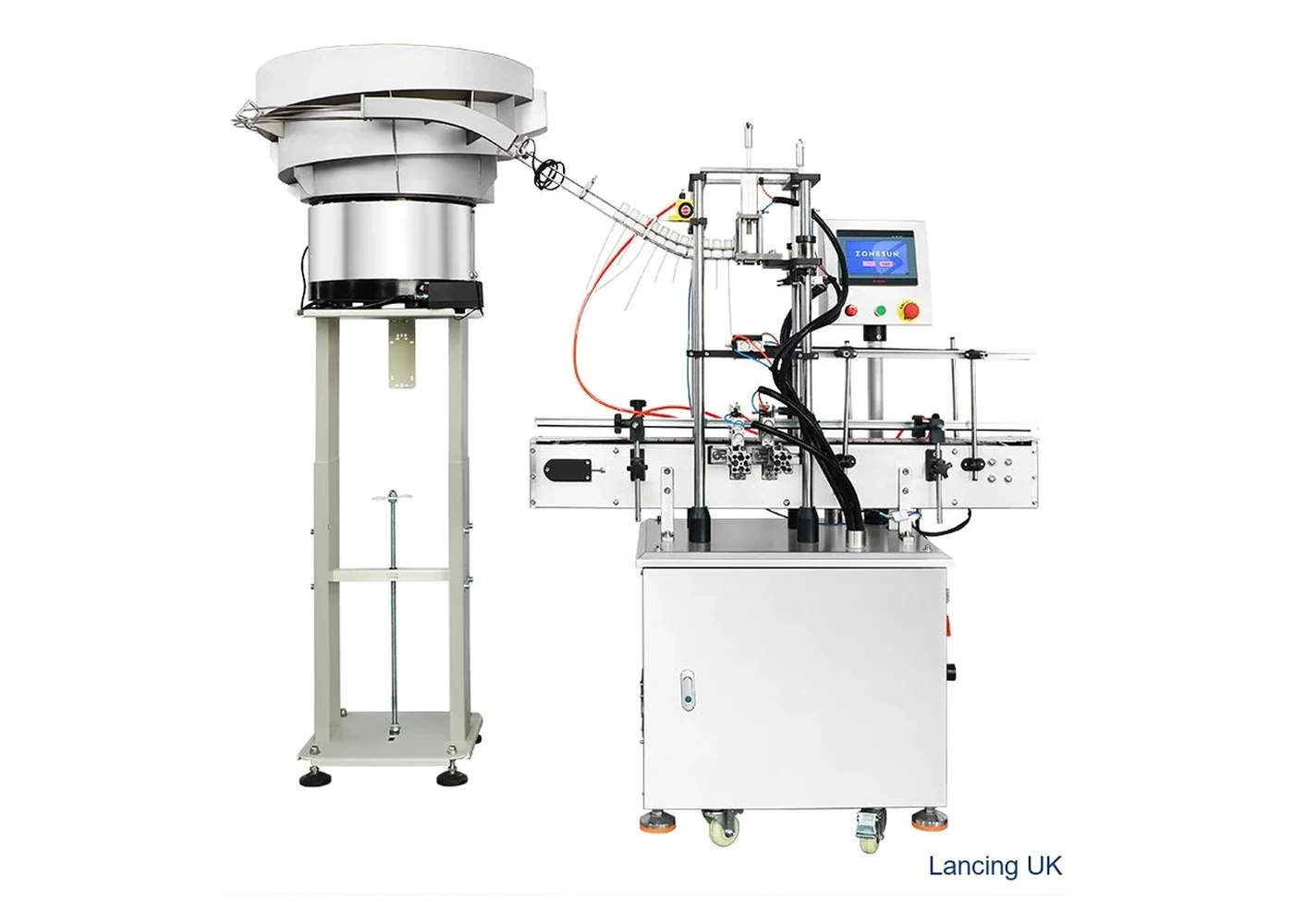
LU-XG6100 class
Published first-party model image used as a visual reference. Final guarding, tooling and line arrangement are confirmed for the quoted machine.
Selection boundary
This model is best treated as an operator-assisted capping station rather than a miniature automatic line. Its value is the controlled clamp-and-tighten cycle; sustainable output still depends on bottle handling, cap presentation, inspection and replenishment.
Short and medium batches where one operator can present bottles and caps at the required pace and the closure is a pre-threaded screw type.
Tall, lightweight or flexible bottles, closures with liners or tamper features, and caps that need a non-standard chuck or unusual engagement sequence.
Use an automatic inline or spindle capper when manual bottle and cap presentation becomes the limiting step or when the machine must exchange signals with a complete line.
Production evidence
The machine cycle starts before the capping head moves. Confirm how the operator picks up the cap, starts the thread, locates the bottle, initiates the cycle, removes the finished pack and performs the required quality check. A fast isolated cycle does not prove sustained production if the operator cannot replenish components or manage finished bottles safely.
Use filled production bottles and closures from normal supply. Confirm that the cap starts squarely before tightening.
Check that the clamp supports the pack without marking, crushing or allowing rotation.
Agree cap height, thread engagement, finished appearance and the site method for checking application or removal torque.
Record chuck identity, head height, clamp position, cycle mode and the approved checks for every format.
Quotation and trial brief
A useful quotation should describe the operating duty and acceptance evidence, not only the nominal bottle and cap diameter.
Provide filled production bottles, every closure variant, component drawings where available, product condition and the least stable or most difficult format.
State required accepted output, batch size, shift pattern, changeover frequency, operator tasks and whether cap placement is manual or automatic.
Provide the layout, conveyor direction and height, available space, utilities, connected machinery, control requirements and the quality checks used to release the finished pack.
Buyer questions
These answers clarify the model boundary before a formal sample and project review.
No. Bottle and cap presentation remain operator tasks. The machine automates bottle clamping and the tightening cycle, which can improve repeatability without adding an automatic conveyor and cap feeder.
The published reference uses an OD 8 mm air connection for the bottle-clamping function. Final pressure, supply quality and connection details should be confirmed in the quoted machine specification.
A pump or trigger may require different gripping, dip-tube control, head orientation or cap presentation. Treat the published screw-cap envelope as a shortlist only and include the complete closure and tube in the trial.
Send filled bottles at the intended operating condition, each closure variant, drawings where available, the required output, batch pattern, acceptable finished-pack checks and photographs of the proposed operator area.